Class Readings that Resonate



Arasaratnam-Smith, L. A. (2017). Intercultural competence: An overview. In D. K. Deardorff & L. A. Arasaratnam-Smith (Eds.), Intercultural competence in higher education (pp. 7-18). New York: Routledge.
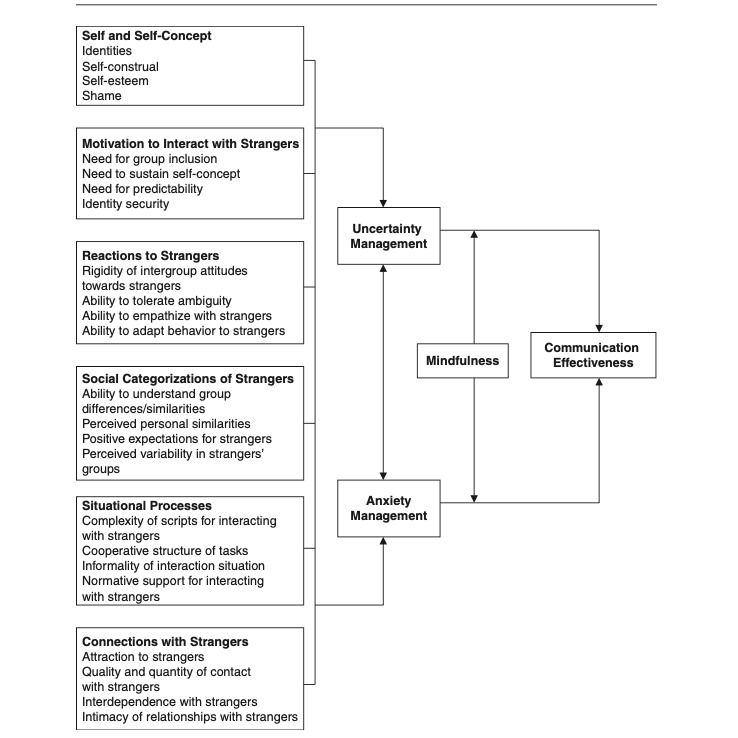
The article from Arasaratnam-Smith (2017) provides fundamental knowledge about intercultural competence. The article started with a brief history of the field and adopted Spicberg and Changnon's (2009) definition of intercultural competence --- "intercultural competence is the appropriate and effective management of interaction between people who ... represent different or divergent affective, cognitive, and behavioral orientations to the world" (p. 7). The author also introduced 7 models and frameworks of the development of intercultural competence, including Deardorff (2006) Process Model of Intercultural Competence; Arasaratnam (2006) The Integrated Model of Intercultural Communication Competence; Fantini (2009) Intercultural Competence Dimensionsions; Byram's (1997) Intercultural Competence Model; Bennett (1986) Development Model of Intercultural Sensitivity and Gudykunst (1993) The AUM Model.
Dimitrov, N., Dawson, D. L., Olsen, K. C., & Meadows, K. N. (2014). Developing the intercultural competence of graduate students. The Canadian Journal of Higher Education, 44(3), 86-103.
This study explores how teaching development programs may facilitate the development of intercultural competence in graduate students and prepare them for communicating effectively in the global workplace after graduation. The framework that the authors applied in the article --- Intercultural Teaching Competence (ITC) could be useful for researchers who are interested in studying teachers' intercultural competence. According to the authors, ITC combines multiple concepts and models, such as IC models, ICC models, educational development, educational psychology on effective teacher behaviors, and inclusive teaching. Therefore, ITC goes beyond the knowledge and behavioral level of IC. It also includes specific teacher skills, behaviors, and teaching approaches that facilitate learning in the context of the culturally diverse classroom. Furthermore, the authors introduced effective teaching methods and approaches to improve international students' intercultural competence. For example, the author illustrated the benefit of using presentations to facilitate the development of students' intercultural competence. Students could gain confidence during the microteaching sessions when they received positive feedback from peers. To help audiences better understand the key concepts of the presentation, students need to modify their speech, such as slowing their speed, repeating main points, making complex ideas simple, and using transition phrases. Presentation, therefore, is a two-way dynamic communication that involves both speakers and listeners. It helps students “learn strategies that facilitate communication in a multicultural or multidisciplinary environment” (p. 96).
Walton, J., Priest, N. & Paradies, Y. (2013). Identifying and developing effective approaches to foster intercultural understanding in schools, Intercultural Education, 24(3), 181-194.
This paper provides a systematic review of education literature focused on identifying school-based approaches for developing students’ intercultural understanding. A key finding from the review is that developing students’ intercultural understanding beyond cultural awareness requires students and teachers to take a critical approach toward cultural diversity. The authors argued that many students felt afraid or resistant to 'difference' because they lacked a way of understanding and talking about differences. Another key finding of this review was that the most significant change in students’ ICU occurred through positive personal interactions with people from diverse cultures. As a Mandarin teacher, I feel strongly related to this argument. In my class, I have students from different countries and cultural backgrounds. Building a positive student-student relationship and teacher-student relationship is really important. Therefore, I adopted the Task-Based Language Teaching method since the problem-solving process could help students develop personal relationships inside the classroom. Also, each semester, we have 3 'special activities', such as eating in a Chinese restaurant, going to a Chinese art exhibition, and watching a Chinese movie. Through these outside classroom activities, the power dynamic between students and teachers gets relieved.
Deardorff, D. K. (2017). The big picture of intercultural competence assessment. In D. K. Deardorff & L. A. Arasaratnam-Smith (Eds.), Intercultural competence in higher education (pp. 124-134). New York: Routledge.
Assessment of intercultural competence remains a crucial issue at higher education institutions around the world. As Deardorff (2017) argued, there is no one ‘right’ approach or ‘best’ measurement tool for assessing this complex concept. Therefore, this article begins by outlining key principles in intercultural competence assessment, such as Define, Prioritise, Align, Identify evidence, and Use. This article also highlights some issues in intercultural competence assessment as well as exploring some key considerations to take into account. After reading the article, I think the biggest challenge of being able to assess intercultural competence is the lack of assessment training for teachers, staff, and academics in international education. As Deardorff (2017) argued in the article, assessing intercultural competence is really context-specific. All five key principles that are foundational to assessing intercultural competence relate to 'context'. Therefore, teachers, who understand the context the best, need to have sufficient knowledge regarding the assessment design for their class. However, as Deardorff (2017) mentioned, too often in international education, teachers and academics have every little to no formal training in assessment.


© 2019 by Xiaowen Chen (Sylvia) M.S. & M.Ed. Proudly created with Wix.com